By Tatiana Zoe Barnes
Anne Mason was born on 22nd October 1937 at London’s Welbeck Hospital, the younger daughter of Basil Mason and Mary Braime. Both of them came from the West Riding of Yorkshire, or what used to be known as “posh Leeds”. Her father was a playwright and screenwriter in the British film industry of the 1930s and 40s, writing scripts, dialogue, and adaptations for over 30 – mostly B – movies such as Death at Broadcasting House and The Silent Passenger, which introduced the famous gentleman sleuth, Lord Peter Wimsey, to cinema audiences for the first time. Her mother Mary was among the first generation of women to study for the Economics Tripos at Cambridge University and subsequently worked for Maynard Keynes at his Nation and Athenaeum magazine and later for its direct successor, the New Statesman and Nation, handling the editorial admin for notable literary figures like Kingsley Martin and Virginia Woolf.
So Anne and her beloved elder sister Judith grew up in what was a bohemian milieu. The family home in Hampstead was often full of journalists, art critics and writers like Malcolm Muggeridge, Herbert Read and Patrick Hamilton. Basil and Hamilton were particularly close friends and used to spend a lot of time drinking together in the pubs of Fitzrovia, something Hamilton could afford to do, thanks to royalty cheques from Gaslight and Rope. Basil – not so much! But life was chaotic. Anne’s mother Mary was a lovely person and a charismatic hostess but she was also “highly-strung”, as they used to say in those days, often having to “take the rest cure”, as they also used to say, which meant that Basil’s sister Gladys – or “Tanta”, the children’s mispronunciation of Auntie – helped bring up Anne and Judith.
When war broke out, the Mason family moved out of London to escape the Blitz and settled in Hambleden, a quintessentially picture-postcard village in South Buckinghamshire, where their neighbours and friends included the Mathieson family as well as another family called the Barneses. Patrick Hamilton also came to live at the Mason home during the war, ostensibly to dry out – though Anne remembers him single-handedly drinking a bottle of whisky most days before lunch – but also to write his greatest novel, The Slaves of Solitude, which is set in a fictional Hambleden.
After boarding school at Godstowe and Wycombe Abbey, Anne went up to Oxford in 1956 to read English at St Hugh’s where she met her soon-to-be best friend Susie Lindup (later Pedder) as they were dragging their heavy suitcases through the college gates.
After Oxford, Anne trained as a teacher and moved into a flat with Susie in Ladbroke Grove two doors down from the one she lived in until the end of her life. Much of North Kensington was a slum at the beginning of the 1960s. The Notting Hill race riots had taken place only a few years earlier, and for the 1959 general election the fascist leader Oswald Mosley had returned to England in a bid to whip up anti-immigrant feeling by standing as a candidate in Kensington North.
On 21st April 1962, Anne married Mickey Barnes at St Mary’s church in Hambleden. It was a marriage that lasted a lifetime and made them both very happy. A year later they moved next door, still on Hanover Gardens, into a block of flats called Hillcrest, which had only recently been built in a gap left by a German bomb. The following year their son Hugh was born, two years later they moved into Flat 1, 45 Ladbroke Grove, and the year after that their daughter Kate was born.
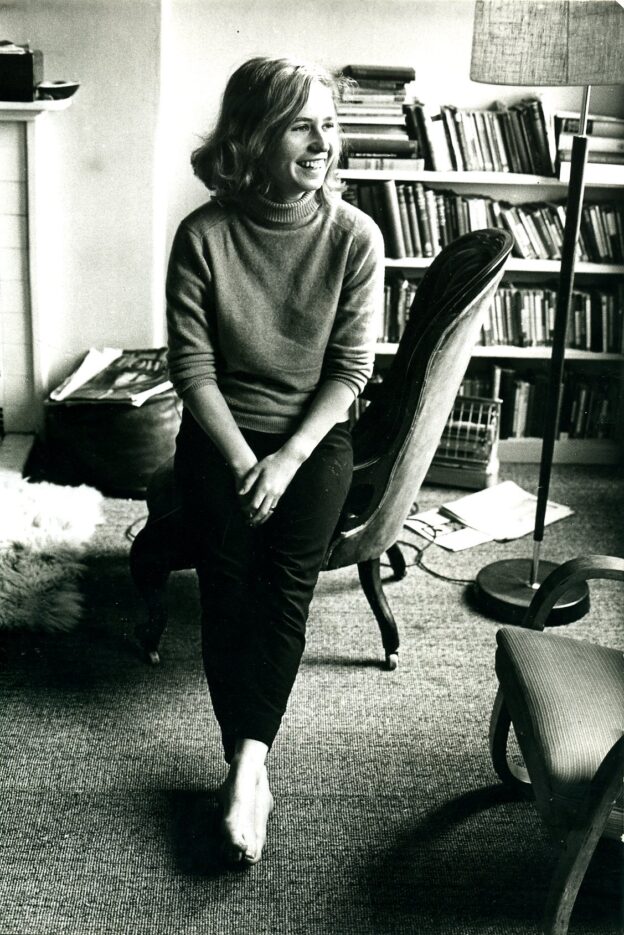
Notting Hill was a hotbed of Labour politics, and they were friends and neighbours of Roy and Jennifer Jenkins, Tony and Susan Crosland, and Tony and Caroline Benn. By all accounts, Anne was a figure in the life of Ladbroke Grove in the Sixties and Seventies. Friends remember her as young and glamorous and full of fun. When, in 1966, the Sunday Times Magazine published a feature about Mickey – the young MP for Brentford & Chiswick – commissioned by Peter Crookston who is here today, it was accompanied by the photo of Anne in the sitting-room at Ladbroke Grove that you see on the front of the Order of Service.
But Anne was not just a political wife. She was also fiercely political in her own right, marching against war in Vietnam, Iraq and Palestine – against Brexit – and supporting Labour’s abolition of the 11-plus, which transformed Holland Park Comprehensive into such an exciting school, where Anne taught for 25 years.
She was, quite clearly, an amazing teacher who inspired her pupils. Alongside Jane Miller, Terry Furlong, Ian Whitwham, Caroline Arrowsmith and others, she turned the English Department into something remarkable, a place where young people could not only learn but could also be heard. The writer and artist John-Paul Flintoff, for instance, wrote recently that “[Mrs Barnes] told me I should read Ulysses. She said to go home and start on Friday evening and keep reading all weekend. Read and read and read, don’t spend too long on anything, keep going and get through the whole book.” Her encouragement was one of the launchpads for his brilliantly creative career – and there are dozens of other similar stories.
In 1981, Anne took a sabbatical from Holland Park to do a Master’s Degree at the Institute of Education, exploring the prejudices that arise from the different ways in which English is spoken in a multi-racial school. The main starting point was her sense that teenagers are powerfully affected by the vocabulary and accents used by their peers and quickly build up an intricate set of almost cult feelings around these linguistic differences. Reading her dissertation shortly before sitting down to write this Eulogy, I was struck by how amazingly contemporary and relevant her argument still is today.
But she was also clear-eyed about the posturing of schoolteachers, and self-deprecating. In the Marxist 1970s, it was de rigueur for teachers, as for other professionals, to burnish their proletarian credentials. Anne was having none of that. Once, Holland Park conducted a survey of the staff members’ class origins. Of the hundred teachers, 65 apparently self-identified as middle-class, 34 as working-class – and one as upper-class! Guess who? Typically, this wasn’t only a joke at her own expense, it was also a deadly serious riposte to university-educated colleagues masquerading as class-warriors. Henceforth Anne was known in the Staff Room as Lady Barnes.
She was a gifted writer as well as a teacher, reviewing books for The Times Educational Supplement and for The Times, under the literary editorship of her friend and neighbour Philip Howard, and contributing to educational journals, as well as publishing book-length study guides for the BBC on Great Expectations, Bleak House, the Mitford Sisters and a History of the English Language, among others. All this she did while playing a key role in the working group to devise a new Key Stage 3 of the National Curriculum, a Thatcherite reform that she may have opposed but nevertheless did her utmost to improve. Towards the end of her career she was a Chief Examiner for GCSE English and General Secretary of the National Association for the Teaching of English (NATE) – and was, as one of her former colleagues wrote after her death, “a hugely influential figure in English teaching at a national level at that time”.
So many people have been in touch with my dad and Katy, over the past couple of weeks, to say how much Anne meant to them, in letters, emails, and text messages. We knew that she was loved by many people, but it has been exceptionally moving to hear people describing exactly what it was about her that was so special. I’ve been thinking a lot about that question, but I don’t think I’ve been able to express it as well as some of those messages. One person wrote about how quickly apparent it was upon meeting her that she was a warm and funny person but that it took longer to spot how clever she was because she trained her interest on others, “encouraging you to keep talking with her yes, yeses and her smile and a push of the hair out of her eyes.” Another person described a memory of Anne arriving to pick up my sister from an after-school playdate and having been met by a scene of utter chaos, children screaming everywhere, food bubbling over on the stove. She walked in and said “Well this is as good as it gets.” Another talked about how she spoke her mind fearlessly. Yet another person described her way of being “though worldly wise, either truly curious or astonished” and that she was “warm and serious and original”. Another wrote that “Just knowing all these years that Anne was here in W11 was one of the best things about living locally, and also that – with luck – you might bump into her.” Not a few people alluded to her questionable cooking, and I was reminded of a lunch a long time ago, when she didn’t have any tomatoes to put in the salad so she threw in some blueberries instead.
When people talk about Anne, they often talk about the way she made them feel. She had an extraordinary ability to listen to people, always with another question to ask. She never got tired of talking. She wanted to know people deeply and to understand why they did the things they did and held the opinions they held, to understand what it was they wanted to do most in their lives and to talk about what they were going to do to get there.
I have heard a lot of stories about 45 Ladbroke Grove in its heyday. All the coming and going, red wine and conversation, laughing and late nights. I wish I could have seen it then. But I don’t find the scene difficult to imagine at all. In fact, the atmosphere that she created around the kitchen table never really changed. Me, my sister and my cousins (and all of our friends!) grew up in the midst of that particular kind of comforting chaos, absorbing Jim’s love of people and of family, seeing how warmly she welcomed anyone who passed through. We all remember Christmas and Easter lunches in Edale – glimpsed in the background on the back page of the order of service: Jim preparing the entire feast herself, with a glass of champagne on the go and six grandchildren running in circles at her feet, somehow managing at the same time to have a conversation over her shoulder about a recent book she’d read. I remember evenings after school, when Jim would serve toast or crumpets to a horde of unruly primary school children, entirely outnumbered and yet somehow completely in control.
Though I was never taught by Jim, I benefitted enormously from being the granddaughter of such an inspirational English teacher. She fed my love of books from as early as I can remember. One story I often tell is about the time my parents (quite rightly) said I was too young to queue up at 4am outside Waterstones to get my hands on the new Harry Potter book as soon as it came out. But I was desperate. So Jim went out in the middle of the night and stood in line for hours, in the cold dark, amongst the Potterheads, just so that she could hand me that book the moment I woke up. I don’t think many other grandmas were in the queue that night.
As young children she was always encouraging of anything we wanted to do. I don’t remember her saying no very often. It didn’t matter if it was half an hour before bedtime, if we wanted to make a cake, she’d say “go on then”. She wouldn’t necessarily help, but nor would she stand in our way. She didn’t mind the mess or the extra work. She wanted us to do things, to embrace new experiences and to never, ever, under any circumstances dare to say we were bored, because only boring people get bored. We made a ridiculous number of inedible cakes.
Even by the time I became an adult, the kitchen at Ladbroke Grove was still the best place to spend a few spare hours. It was a place I often brought my friends to for some free drinks and a laugh. When I met my husband Mark I was so excited about him meeting Jim I dragged him over far too early in the relationship. Jim had not been approving of all of my boyfriends, but I knew she would love him and I needed him to understand how we did things in my family.
It’s difficult for me to describe my relationship with Jim because I’ve never seen it reflected anywhere else. It was more than a grandmother-granddaughter relationship. She made me feel special – but then of course that’s how she made everybody feel, in different ways. We used to bicker all the time. When I said something that irritated her, Jim would come back with “That’s very Greek of you” (I am half Greek) and she knew that nothing would wind me up more. I remember her picking me up from school on rainy days and spending the whole car journey back to Ladbroke Grove arguing about some insignificant thing one of us had said. We’d then park up outside the house, forget what it was that we were arguing about, and sit in the car for an hour talking about anything and everything. Whether it was a falling-out with a friend or a new plan for my life – Jim had an opinion and it was one that I always wanted to hear. Just being in the kitchen with her, with nowhere else to be, plotting the future, was the best thing in the world.
Jim lived a full life. But family was the most important thing to her. All her grandchildren, Daisy, Stanley, Harry, Alfie, Aliki and me – as well as Judith’s children Jane and Mark – adored her. All of them made her very happy and very proud. It makes me sad to think that Jim never really got to know her great-grandson Basil (named after her father) or her great-granddaughter Zoe. But right up to the end of her life, whenever she saw them her face immediately broke out into that wonderful smile of hers. Our lives won’t ever be the same without Anne. But we must cherish our memories of her wonderful life and of how it touched all our lives. She will always be with us.
Photo by David Steen